Thursday, September 13, 2012

Repairs and Servicing

One of the services we offer here at Cley Spy is repairs and servicing of binoculars, telescopes and tripods. We have two in-house engineers who can carry out repairs to most equipment that is no longer covered by warranties and we can arrange repairs of items that need to be returned to the manufacturer. Some of the most common types of repairs we encounter are listed below.

Over 50 years of experiance. Our Head Engineer Maurice
 realigning binoculars

Realignment of binoculars. The most common problem with binoculars is double vision often caused by the prisms getting jolted out of position. This can usually be fixed in both Porro prism and roof prism binoculars by adjusting the prisms or objective lenses with the binoculars on our collimator bench.

Internal cleaning and servicing of binoculars. Many older non-waterproofed Porro prism binoculars get a build up of dust, water marks and even fungus on lens and prism surfaces. Removing this contamination requires completely dismantling the binoculars and so we also service all moving parts while we are at it. This can also be done with some older telescopes.
The internal parts of a Wray 9x40 binocular

Replacing and repairing twist-up eyecups. Being a vulnerable part of binoculars and telescopes these often get damaged. Many current models can have replacement eyecups fitted without having to send them away to the manufacturer.

Tripod repairs. We can perform surgery on most tripods and monopods and if parts are required we carry stock of the most commonly needed bits. We also have a tripod graveyard which is a source of spears for older models that new parts are no longer available for.

If you have any enquiries about repairs and servicing please visit us at our Glandford shop or contact us via phone on 01263 740088 or through our website.

Cley Spy

Monday, July 23, 2012

It's not all about birds!

Binoculars and telescopes are not just used for birdwatching and one of the most common applications is for insects, especially butterflies, dragonflies and damselflies. A good pair of close-focusing binoculars and a telescope really enhance observing some of the less approachable species and where you can't get close to them, for example, dragonflies settled on the other side of a stream or pond. Generally the best close-focus is achieved by 8x32 binoculars and 65mm or 50mm telescopes, but the exceptions to this rule are the Pentax Papilio 6.5x21 and 8.5x21 which both focus down to 50cm (20'').

Dragonflies, damselflies, butterflies, moths and wildflowers are just as rewarding to watch as birds, having endless diversity and the opportunity to find rare, localised and vagrant species. The summer can be a quiet period for birds in the UK, especially during calm sunny weather, but is one of the best times to see insects and so many birders turn their attention closer to the ground. An interest and appreciation of many aspects of the natural world is the best way to ensure that you have an enjoyable experience whatever the time of year.

Not only can you use binoculas and scopes to observe, but it is also possible to digiscope the smaller wildlife. Yesterday I took a Swarovski ATM 65 HD with zoom and UCA camera adapter and my little compact camera to the edge of our pond and in about ten minutes had a few photos and videos of some of the insect activity.

Here are a few of the results of bit of macro-digiscoping.
Broad-bodied Chaser (Libellula depressa)

Broad-bodied Chaser (Libellula depressa)

Azure Damselfly (Coenagrion puella)

Azure Damselfly (Coenagrion puella)

Saturday, July 14, 2012

Zeiss Victory HT and Conquest HD UK launch at Cley Spy

http://www.cleyspy.co.uk/zeiss-c15.html

The new Victory HTs promise outstanding
low-light performance
New high-end binoculars always cause a stir, especially when the manufacturer has set out to create something ground-breaking. The much anticipated new Zeiss HT Victory binoculars are just that, offering unparalleled brightness and the first opportunity to test them out in the UK will be here at Cley Spy's Glandford shop. We will also have the first demo of the Zeiss Conquest HD 8x32 which, if the 8x42 and 10x42 versions are anything to go by, should be extremely impressive.

The Victory HTs promise unrivalled brightness, thanks to a light transmission of up to more than 95% - this unique result is created by the innovative optical concept of the VICTORY HT range. It is made possible by the perfect interplay of SCHOTT® HT glass, the Carl Zeiss T* multi-layer coating and the Abbe-König prism system.
You will be able to try these for yourself using our excellent viewing facilities on Friday the 20th of July from 10:30am to 4pm when Zeiss will bring the first pairs in the country to Norfolk. We will also be taking orders for the first available UK stock.

The view from our Glandford Shop.  Perfect for testing optics 'in the field'

Looking forward to seeing you!

Cley Spy

Saturday, June 30, 2012

Why Cley Spy?


The Glandford Shop with the newly finished viewing shelter
Eleven years ago Cley Spy opened in the front of an old carrot washing barn in Glandford near the North Norfolk coast, stocked with a handful of binoculars and telescopes. Since then we have expanded to become the biggest independent specialist optics shop in the country, with over 180 different models of binocular, over 40 telescopes and our second hand stock all on shelf to be tried and tested. Over the years Cley Spy has become the place to visit for specialist nature watching equipment. We regularly get visitors from all over the country because the range of stock, viewing facilities and expertise we can offer are the best around.
The pond and wildflower meadow behind the Glandford shop
Testing Scopes 'in the field'

House Sparrows on the feeder

The team here are all birdwatchers and optics users and so have been through the process of choosing binoculars and scopes from the initially bewildering array of models. Knowing what it's like to be on the other side of the transaction, we give customers the time and space to try and test all the equipment they want. If you are spending tens of pounds or thousands of pounds on optical equipment you want to know you are investing in the right product. You can only make a valid comparison between two or more binoculars or telescopes if you have them side by side and can repeatedly switch between them. Testing one model in one place and another somewhere else, even if only an hour apart, will not give you an accurate impression of their relative merits. Here at Cley Spy we have the most diverse stock of binoculars and telescopes anywhere in the country so you can test a range of equipment within any budget at your leisure. We will always give advice if needed and discuss the options and your requirements, but ultimately it is what your eyes see that matters. Whilst any group of binoculars or scopes of the same specification and around the same price may be very similar in terms of optical quality, subtleties of design, ergonomics, size and weight can make or brake the suitability of a model.


Just a few of the binoculars in stock
The imprsive view over one of Britain's
best bird reserves from our shop at
Cley Marshes
We have two shops, our HQ at Glandford and a small shop in the old Visitors Centre at Cley Marshes nature reserve. At Glandford in addition to the optics and tripods we also have a range of Paramo and Jack Pyke outdoor clothing, Tilley hats, bird food and feeders, books and toys. In January 2012 we moved to a newly converted barn in the same yard at Glandford that gave us much better viewing for testing optics and the half-acre field which we are turning into a wildlife haven.
Come and visit us to get the best optics experience available!


Cley Spy


Monday, June 4, 2012

Wildlife update

After the very wet bank holiday Sunday the pond has been topped up to the brim and the sun has come out. Three smooth newts a selection of diving beetles and pond skaters have found the pond and are enjoying the weed and lilly pads.


Corn Chamomile and Poppies
The field has come into bloom now and is sporting an impressive diversity of species, from meadow grasses and delicate perennials, to dry waste ground species and the rather unkindly termed “weeds of cultivation”. The main attraction is the spectacle of the deep red poppies growing through the sea of white corn chamomile between the shop and the pond. At the top of the field a much more heath-like environment has developed, with shorter, tougher grasses and flower species associated with dry sandy places like, barren strawberry and fiddleneck.
Common Vetch
Wild Strawberry
Poppy
Field Pansy

Cornflower


Flax sp.


Tuesday, May 22, 2012

Exclusive first test of the new Viking 80mm ED scope

Dark and mysterious. The as yet unnamed Viking scope.
Thanks to Tim the Viking we have had a chance to test one of a new range of scopes coming on market this summer. The name and exact price of this new model are yet to be confirmed, but it will be coming in at sub-£1000 with an 80mm and 65mm version. The un-badged pre-production example of the 80mm we have been given to test is a fully specified sample that is identical in terms of build quality and optics as the production models will be.

First impressions are of a slim medium-weight 80mm scope with barrel focusing, slightly matt finish rubber armouring, a sturdy feeling lockable bayonet eyepiece mount and a 25-75x zoom. The important bit is what you see through it however and it does not disappoint here either. The image trough the ED glass is sharp and bright with virtually no fringing and both the contrast and colour fidelity are excellent for a scope of this price. The comfort is also striking, the rounded twist-up eye cup fits the eye nicely and the focusing ring is responsive with no play and just the right amount of smooth damping to be easily controlled.

We are looking forward to getting these in stock as they will be a serious contender for anyone looking to get a high quality scope for less than £1000.

Watch this space for more information on exact price and availability.

Cley Spy

Saturday, May 12, 2012

Tripods and Heads

To get the best out of any telescope you need to have it mounted as steadily as possible, so a good tripod suitable for your requirements is essential. First of all we must look at the anatomy of a tripod. Essentially there are two elements: the legs and the head. Many of the lower cost tripods available (£40-£100) come as a kit of legs and head, when spending a little more you get the option of making your own combination.


The legs are the part that gives the majority of the stability and the weight of the tripod, and here there are two key specifications to consider: the material they are made form and the overall size, both when folded and fully extended.

Carbon fibre is a woven
 material giving strength
 in all directions.
There are two types of material commonly used for legs. Most are made from aluminium alloy, being both light weigh and strong, but if you want the best combination of low weight and maximum rigidity then carbon fibre is the way to go.

The head is the critical interface between the tripod and scope, an inappropriate or poor quality head can spoil a good scope so this is the part to get right. Below are the three main types.


2-way (pan and tilt) and video heads.
The Manfrotto 128 head easily supports
even the heaviest scopes.
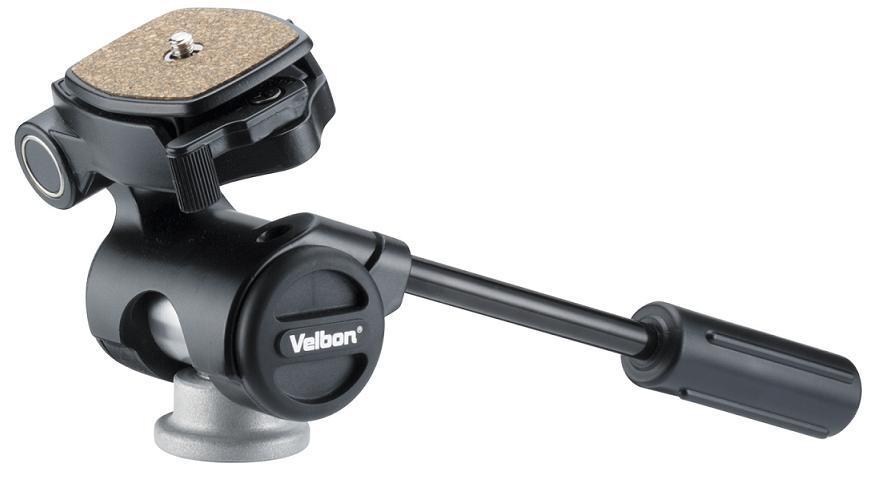
Velbon PH-157Q
These are generally the best for use with scopes, having the minimum number of moving parts. The best head we have come across in the last 11 years is the Manfrotto 128 RC2, which gives a beautifully smooth movement and has proved to withstand even the most extreme amount of use and weather conditions unscathed. This type is the best for a scope and is good for wildlife photography with a telephoto lens, especially birds in flight. The Velbon PH-157Q is primarily a 2-way head, both movements controlled with one handle, but the top can be flipped through 90° to allow for portrait format shots.

3-way (pan, tilt and landscape/portrait orientation) heads.
These are designed to be compatible with both scopes and for photography. This type is often lighter than a fluid video head but are usually less controllable. Great for switching between a scope and landscape or macro photography.

Ball heads.
Primarily for photography, these offer the greatest freedom of movement. This quality is desirable for taking photos with wide angle and macro and standard lenses, but can be very awkward for a telescope.

The size of tripod you require depends both on your hight and on where you intend to use it. For general use a three-section leg tripod (one with two clips on each leg) is often the best, but if you want it to fit in a rucksack or a suitcase for travelling abroad then a four-section leg will retract to a smaller size.
When it comes to carrying a scope and tripod together there are a couple of options, a shoulder strap attached to the tripod or one of our Mule Packs, which effectively turns the tripod into a backpack. Having the weight supported on both shoulders makes the scope and tripod seem lighter and leaves you hands completely free for using your binoculars. It can be tempting to carry your kit by the strap on the scopes case with the tripod hanging below, but in our experience this can strip the thread on the foot of the scope which can lead to expensive repairs.


Visit us at Glandford and Cley Marshes to try out our tripods.

Cley Spy